Watch with Pip
A guided explanation introduces the idea and shows what to try.
Your Own Animated Short
Shot planning, movement and timing — turning still pictures into a short film with sound.
Start with just $1. One lesson to keep. No automatic subscription. Explore all 8 lessons ↓

Watch, try, and create inside CreatorKids. No separate AI accounts to set up.
START WITH SOMETHING SMALL — $1
Read what a camera move means before anyone explains it, then invent the hero the whole short is about.
Your hero, with one tell, and the sentence the whole short is built on: somebody wants something
That is the first step — not yet a 30-second animated short with sound. The whole course is 8 lessons for $9.99, and your $1 counts toward it.
Explore the $1 starting optionGUIDANCE, WITH ROOM TO TRY
A guided explanation introduces the idea and shows what to try.
Use the course tools to experiment, make choices, and try again.
Keep building their project, with something new to show you.
WHAT THEY WORK TOWARD
Shot planning, movement and timing — turning still pictures into thirty seconds that actually move.
TAKE A LOOK INSIDE
8 lessons. Open any lesson below to see what they will do.
Same picture, two speeds, and you already know what each one means. Today you find out that in animation every move is a decision - and you make the somebody your short is about.
They finish with: Your hero, with one tell, and the sentence the whole short is built on: somebody wants something
Thirty seconds is longer than you think, and every short ever made fills it the same way: a set-up, a turn, and a pay-off. Today you write yours in three lines, and make the other thing - the one that gets in the way.
They finish with: Your short in three lines - set-up, turn, pay-off - and the other thing that gets in your hero's way
The same moment, filmed from three places, says three different things. Today you learn the three shot sizes and what each one is FOR - and you make the place your short happens in.
They finish with: The place your short happens in, made twice: once empty and wide, once with your hero small inside it
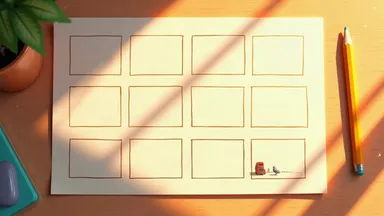
Stop planning. Today the whole short goes on one board - eight slots, in order, a size and a line for each - and you find out which of your three parts has no picture yet.
They finish with: Eight shots on one board, in order, each with a size, a line and a picture
Five camera moves, and every one of them means something. Today your eight pictures start to move - one move per shot, each with a reason, and at least two shots that hold completely still.
They finish with: A camera move chosen for every shot, with a reason, and at least two shots that hold still
The same eight pictures, in the same order, can be dull or brilliant - and the only difference is how long each one stays. Today you turn the third dial, and find out where the wait goes and where the punchline lands.
They finish with: Every shot given a length - one wait, one punchline, and a rhythm you chose on purpose
Your film has no words yet, and it already works. Today you give it a narrator - a somebody, not a voice - and find out that the best line on most shots is no line at all.
They finish with: Your narrator's voice, and eight lines - some of them blank
The lines go on the shots, a title goes on the front, and the film gets made. Then the only test that matters: somebody who knows nothing watches it, and you watch them.
They finish with: The finished short, and somebody who has watched it and told you what it was about
TOOLS, SAFETY & PRIVACY
You pay, then choose a password. Your child signs in with a first name and, if you want, an age range you pick from a short list. Never a surname, date of birth, school, address or photograph.
Their pictures, notes and projects are in their portfolio, open to you whenever you are signed in. Ask us and we will show you everything we hold, delete all of it, or stop collecting more.
What your child types is run through a safety filter before it reaches the image tool, and the picture is checked again when it comes back. Pictures are only ever shown to a signed-in member of your family — a link on its own is not enough.
The tools run on our server, on our account. Your child never signs up with an AI provider, never agrees to anyone else’s terms, and nothing they type is attached to an identity outside CreatorKids.
What they type and make is kept so a person can review it for safety. It is not used for advertising, profiling, or training any model. No advertising cookies and no third-party trackers run anywhere your child goes.
Creations and portfolio stay while your account is open and for 30 days after you close it. Safety logs are kept for 12 months. If we ever change what we collect, we email you first.
The full detail, in plain words: our privacy policy.
A FEW THINGS PARENTS ASK
No. Each lesson shows what to do before asking them to try it, and they type descriptions in their own words. The tools are inside the lesson, with nothing to set up.
No. Lesson 1 is the first building block: they finish it with your hero, with one tell, and the sentence the whole short is built on: somebody wants something. A 30-second animated short with sound is what the whole 8-lesson course works toward, and it comes together in the final lesson.
No. It is one payment of $1 for Lesson 1, yours to keep and replay. Nothing renews and there is nothing to cancel. Only the membership renews, monthly, and only if you choose it.
No. The guided AI tools and activities used in this course are inside CreatorKids. You do not need a separate AI subscription. Included image allowances apply; they are not unlimited.
Yes, and they are sized for the course. Lesson 1 includes 15 pictures. The full course includes 100, which never expire. Membership includes 120 a month across the whole library. Running out never takes the course away — only making new pictures pauses, and you can top up from the parent page.
Yes. It runs in the web browser with nothing to install, on a laptop, Chromebook or tablet; a larger screen gives the activities more room.
You handle the purchase and the two-minute set-up. After that the lessons are written for a child to follow on their own, at the pace of the video, with a trusted adult nearby for questions. Some activities invite a family conversation, and the end of the course is something they will want to show you.
Your $1 buys Lesson 1 to keep and replay. Nothing renews automatically. If you choose the full course later, that payment is credited and the upgrade is $8.99.
Start with one lesson for $1, buy this whole course for $9.99, or choose library access for $19.99/month. The first two are one-time purchases. Membership renews monthly until you cancel.
Yes. The yearly option is $149/year for the same library access. You can compare it with the monthly option on the membership page. Membership access continues through your paid period if you cancel; separately purchased courses remain yours to revisit.
No. Lessons are self-paced. Pause for an activity, replay an explanation, and come back when it suits your family. A course you buy outright is yours to keep; membership access lasts while subscribed.
Something else on your mind? Ask us.
THEIR NEXT “LOOK WHAT I DID” MOMENT
Begin with $1, choose the whole course, or explore together with membership.
First lesson: one payment. No automatic subscription.